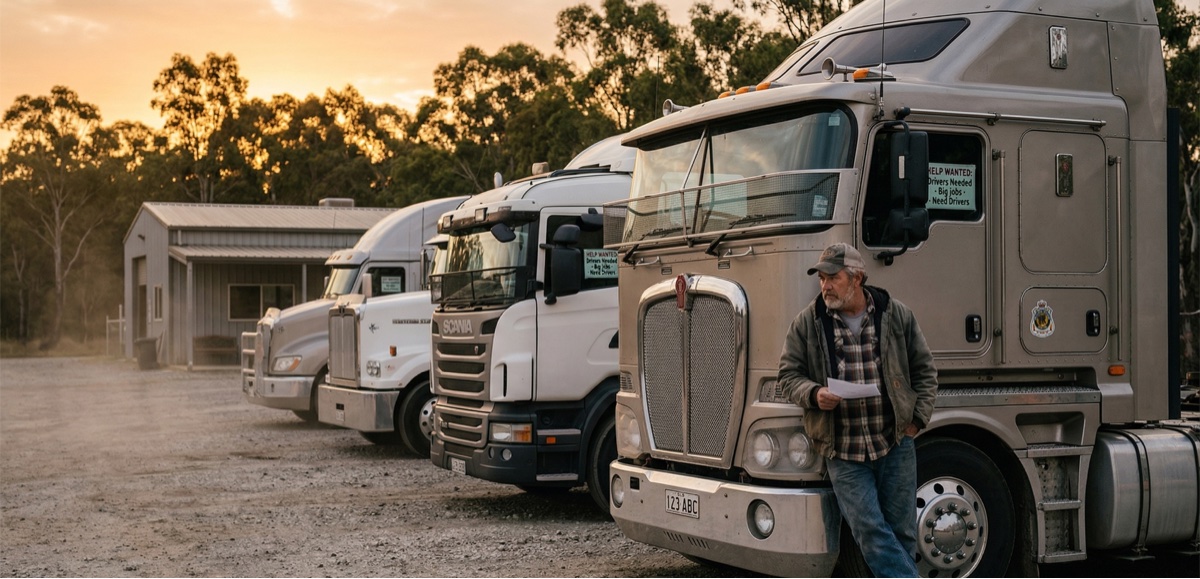
If you've been trying to hire HC or MC drivers in the last two years, you already know this. You don't need a think-piece to tell you the market is tight. You've lived it — the ads that get no responses, the applicants who ghost after the second call, the experienced driver who accepted your offer on Friday and rang Monday morning to say they'd taken something else.
The driver shortage is real, it's now, and it's not evenly distributed. The big carriers are insulating themselves. Small operators are absorbing the hit.
Australia's trucking workforce has an ageing problem that's been building for decades and is now coming to a head. The average age of a heavy vehicle driver in Australia sits above 45. The cohort of experienced drivers who built their careers in the 1990s and 2000s is approaching retirement age at a rate that isn't being matched by those coming in at the other end.
The pipeline into the profession has been thin for a long time. Heavy vehicle licences are expensive to obtain; getting an MC licence can cost $5,000+ once you factor in the training, assessments, and time off from other work. There's no meaningful government-subsidised pathway for most people. The carriers who trained their own drivers at scale, often through cadetship-style programs that don't exist anymore, have been replaced by an expectation that drivers arrive licence-in-hand.
Meanwhile, lifestyle expectations have shifted. Long-haul interstate driving, the backbone of the freight industry, asks a lot of people. Weeks away from home. Irregular hours. Physical work. Limited certainty about when you'll be back. Younger workers, broadly speaking, are less willing to make those trade-offs for the wage levels the industry has historically paid.
The result is a workforce that's contracting from the experienced end faster than it's growing from the new end.
Major freight operators have responded to the shortage in ways that small carriers simply can't match.
Sign-on bonuses have become common in metro markets. Guaranteed weekly hours, regardless of whether freight moves. Structured rosters with predictable days off. Fleet equipment that's newer and more comfortable. Enterprise agreements with higher base rates than an owner-operator can offer.
This isn't just about money. It's about certainty. A driver choosing between a job at a 20-truck carrier and a job at a national operator is often choosing between two similar hourly rates, but one comes with a predictable roster, modern equipment, and the feeling that the company will still be there next year.
Big carriers have also started investing in driver development, internal HC and MC upgrade pathways that let drivers progress within the organisation. That's a retention mechanism that small operators struggle to replicate when there's no internal ladder to climb.
This isn't a story about small carriers being helpless. Some of them are retaining drivers better than their larger competitors, and it's worth understanding why.
Flexibility. A small carrier can offer the driver who needs to be home by school pickup a run that makes that possible. A national operator running centralised scheduling can't. The people-first flexibility that's harder to deliver at scale is a genuine competitive advantage for operators who use it intentionally.
Relationships. Drivers at small carriers often have a direct relationship with the owner. They know their concerns will be heard. There's no HR department between them and a decision. That matters more to a lot of experienced drivers than it gets credit for.
Local work. There's a growing cohort of experienced long-haul drivers who are done with interstate runs and want to be home every night. Local and regional work, the bread and butter of many small operators, is actually attractive to this group. The operator who can offer a consistent metropolitan or short-regional run has something the long-haul specialist doesn't.
Stability over novelty. Small carriers that have a consistent book of work, reliable pay, and minimal drama often retain drivers better than operations that are growing fast, changing constantly, and creating uncertainty. Boring, predictable, and well-managed is attractive to someone who's been in the industry for twenty years.
One thing that doesn't get enough attention: the cost of getting a heavy vehicle licence is a meaningful barrier to new entrants that the industry hasn't collectively solved.
A young person who might consider trucking as a career faces thousands of dollars in licence costs before they can legally drive the equipment. Compare that to other trade apprenticeships, where you get paid to learn from day one. The economics don't favour the choice, and it shows in the numbers coming through.
Some carriers have started paying for licence upgrades for existing employees, taking someone with an MR licence and funding the path to HC or MC in exchange for a minimum commitment period. It's not a universal solution, but it's one of the more practical approaches to building a pipeline from within rather than competing for a pool that's shrinking.
The demographic reality isn't going to resolve itself quickly. The drivers who are 55 and heading toward retirement in the next decade are a structural loss that can't be offset by competing harder for the same small pool of available workers.
The carriers who weather this best will be the ones who think about driver retention as a strategic priority rather than an HR function. The ones who build a workplace that experienced drivers want to stay in. Who find ways to fund licence development. Who uses the genuine advantages of small-operator flexibility instead of trying to out-spend the nationals on sign-on bonuses.
The shortage is here. The question is whether you're building an operation that's attractive enough to keep the drivers you have. Or one last passing thought, just wait for automated self-driving trucks 😉.