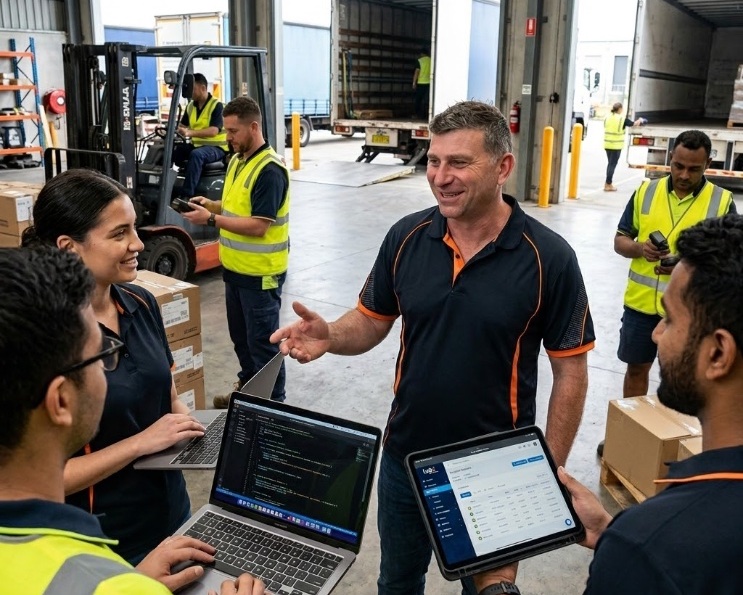
A lot of software in transport sounds good in a demo. The dashboard looks clean. The features sound impressive. The workflow makes sense on paper. Then it meets a real depot.
That is usually where the cracks show.
Dispatch is messy. Freight does not arrive in a perfect sequence. Customers ring at the worst time. Drivers are on the move. Rates are rarely simple. The office needs answers quickly, not another system that creates more steps.
Freight360 came out of that reality.
Freight360 was not built from a theoretical workflow or a wishlist created in a boardroom.
It was shaped alongside a real freight operation in Gold Coast and Brisbane, working through the everyday problems that smaller and mid-sized carriers know well:
Those are the kinds of problems that quietly drain time and margin. They are also the kinds of problems generic software often struggles with.
When software is shaped close to a live operation, the standard for “good enough” changes. A feature cannot just look right. It has to hold up when the depot is busy, when the plan changes, and when the office needs to move fast.
That is why Freight360’s product story is not really about adding more features for the sake of it. It is about building a practical system that supports the work that carriers are already doing.
The value for many carriers is not “more software”. It is fewer gaps between the steps.
That means:
That is the kind of change that makes a system useful day to day.
One of the strongest parts of working with Freight360 is that implementation is not treated as an afterthought.
That matters because most smaller carriers do not fail to modernise because they do not want to. They get stuck because they cannot afford a messy rollout.
Carriers do not need software that wins a beauty contest. They need software that fits the way freight actually moves. That is what makes the Freight360 story worth telling. Not that it is “innovative” in an abstract sense, but that it has been shaped around the practical realities of running a freight operation.
Book a Discovery Call →
If you want to see how Freight360 could fit your workflow, we can walk through your current process and show you where the platform can reduce admin and improve visibility.